
On this page
- Which trailers do you repair: dry vans, flatbeds, reefers, tankers or dumps?
- Air-ride and airbag replacement: what does the job involve?
- Lights, wiring and ABS: why do trailers fail inspection?
- Brakes and landing gear: what do you replace?
- Floors, doors and welding: what do you fix?
- What does the annual inspection check on a trailer?
- Which trailer parts do you work on?
- Repair or replace: air springs, leveling valves, floors and panels
- Trailer jobs
- How does a trailer repair go at the shop?
- Is there room to bring a trailer to the shop?
- Questions
Which trailers do you repair: dry vans, flatbeds, reefers, tankers or dumps?
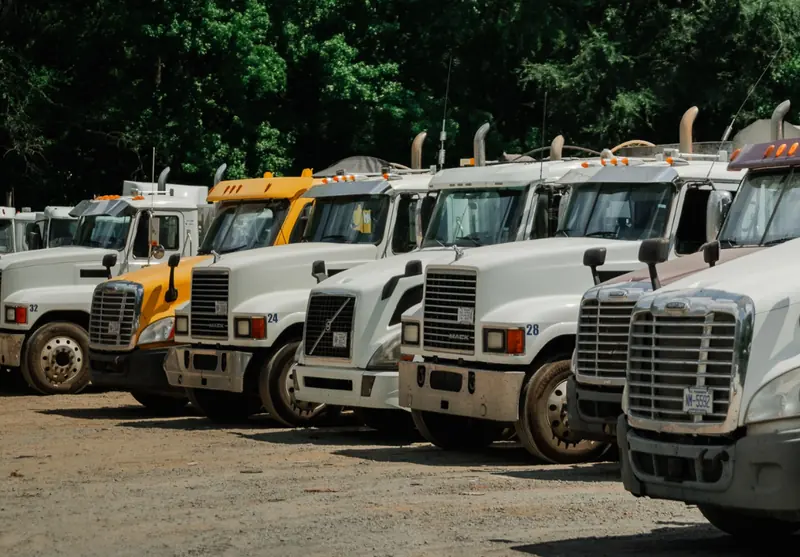
The shop repairs dry vans, flatbeds, reefer trailers and dump trailers in-house, along with the running gear on tankers.
Most trailer types share the same running gear: air ride or spring suspension, S-cam or disc brakes, ABS, lights and landing gear. They differ above it, in a van's floor, walls and doors, a flatbed's deck, a reefer's refrigeration unit, a tanker's tank and valves, and a dump's hoist or gates.
On a tanker, the shop works on the running gear: suspension, brakes, ABS, lights and landing gear. Repairs to the tank itself are not done here, and repairs to DOT specification cargo tanks have their own registration rules.
On a reefer, the running gear under the refrigeration unit is the same as a dry van's, and it is repaired the same way.
Air-ride and airbag replacement: what does the job involve?
Trailer air bags and leveling valves are both replaced in-house, and road calls cover trailers as well as trucks.
A trailer air spring is a rubber bellows carrying the trailer's weight on air, and a leveling valve adds air as the trailer is loaded and lets it out as the load comes off, so the trailer rides at the same height.
A trailer air bag replacement generally covers:
- Supporting the trailer safely, with the air let out of the suspension
- Replacing the air spring, and the fitting or line if either is damaged
- Checking the leveling valve, its arm, and the spring on the other side
- Airing up, checking for leaks and checking ride height
An air bag on its own is one of the shorter trailer jobs. It runs longer when a line, a fitting or the leveling valve has to be replaced as well.
The rubber cracks with age and weather, chafes where it rubs a tire or a brake part, and folds and wears through when the trailer runs with the bag flat. A leveling valve that sticks can leave the springs flat or overfilled.
Trailer air ride runs on air from the tractor, and 49 CFR 393.207 limits air suspension leakage to 3 psi in five minutes at normal operating pressure. Tractor air springs are covered on truck suspension repair.
Sources: 49 CFR 393.207
Lights, wiring and ABS: why do trailers fail inspection?
A trailer fails on lights when a lamp or reflector that Part 393 requires does not work, and on ABS when its malfunction lamp does not come on and go off as power is applied. Corroded connections and chafed wires are behind many dead lamps.
Lights were the fifth most cited vehicle out-of-service violation at CVSA's 2026 International Roadcheck, with 1,659 violations across North America.
Power reaches the trailer's lamps from the tractor through the 7-way cord and plug and then the trailer's harness, so a fault can sit on either side of the plug. One customer's turn signal fault was traced from the tractor back to the trailer. See truck diagnostics for how electrical faults get traced.
Air-braked trailers built on or after March 1, 1998 must have ABS and an ABS malfunction lamp (49 CFR 393.55). A trailer lamp that never lights is an inspection defect. One that stays lit usually means the ABS has logged a fault that needs reading.
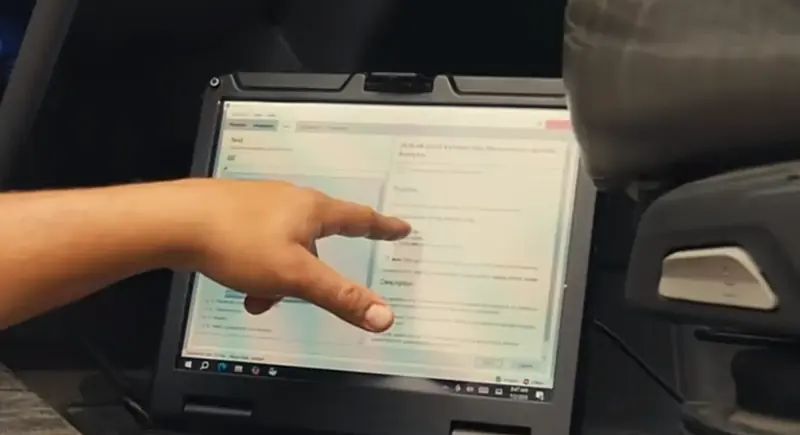
Trailer lights, wiring and ABS are repaired in-house: rewiring, 7-way plugs, cords and harnesses. Trailer ABS faults are read with heavy-duty diagnostic software that covers the major makes, and cleared once the fault is fixed.
Sources: FleetOwner, August 26, 2026 · 49 CFR 393.55 · Appendix A to Part 396
Brakes and landing gear: what do you replace?
All of them, in-house: shoes, drums, pads and rotors, brake chambers, slack adjusters, relay valves, gladhands, and landing gear legs, gearboxes and feet.
Trailer brakes are the same S-cam drum and air disc brakes found on tractors, adjusted and inspected the same way. See truck brake repair for slack adjusters, stroke, and what puts a vehicle out of service for brakes.
The trailer gets its air from the tractor through two gladhands: the supply line, usually red, fills the trailer's tanks, and the control line, usually blue, tells the brakes when to apply.
Landing gear holds up the front of a dropped trailer, and common trouble is gears stripped or seized for lack of grease, bent legs, and broken or missing feet.
Floors, doors and welding: what do you fix?
Floors, swing and roll-up doors, and side and roof panels are all repaired in-house, and customer reviews describe a trailer patched up.
Welding and fabrication are done in the shop too. On a trailer, welding often means a cracked crossmember, a broken bracket or a bent rear impact guard.
A van floor takes forklift traffic, and damage shows as soft spots, broken boards and holes. Swing doors wear at the hinges, lock rods and seals; on a roll-up door it is the springs, cables and rollers.
What does the annual inspection check on a trailer?
A semi trailer gets its own federal periodic inspection, separate from the tractor's, covering at least Appendix A to Part 396 within the previous 12 months. On a trailer that includes the brakes and ABS, lights and reflectors, suspension, frame, tires, wheels and rims, and the rear impact guard.
Rear impact guards joined that list under an FMCSA rule that took effect December 9, 2021.
Dennis along with his crew is one of the nicest and most honest men I’ve come across in this field. Him and his team went above and beyond to make sure my trucks and trailers are maintained 100%.
The shop does annual inspections on trailers as well as tractors.
See DOT inspections for how the inspection works, and fleet maintenance for keeping trailers on a schedule.
Sources: 49 CFR 396.17 · Appendix A to Part 396 · FMCSA rear impact guard rule, 2021
Which trailer parts do you work on?
The parts named in customers' reviews are grouped first. The rest are the usual scope of trailer repair.
Every trailer part listed here is repaired or replaced in-house.
Named in customer reviews
From customers' Google reviews.
Suspension and brakes
Lights and ABS
Body and structure
Trailer types
Rules
The shop behind the work
- Technicians
- About 20
- Service trucks for road calls
- 4
- Trucks we run ourselves
- 55
- Warranty on repairs, by part
- 1 to 3 years
Repair or replace: air springs, leveling valves, floors and panels
| Part | A repair does the job when | It needs replacing when |
|---|---|---|
| Air spring | The leak is at the fitting or the air line, and the bellows and piston are sound | The rubber is cracked, chafed, bulging or blown, or the piston is damaged |
| Leveling valve | The arm is bent, broken or out of adjustment, or a line to the valve leaks | The valve itself leaks, sticks, or will not fill or dump the springs |
| Floor | The damage is a small hole or a few boards, and the crossmembers under it are sound | Soft spots or broken boards run across a large area, or crossmembers are damaged |
| Side or roof panel | A patch can cover the hole or tear and fasten to sound posts, rails or roof bows | The damage runs across posts or rails, or the panel has pulled loose along its length |
All four are repaired or replaced in-house at the Indian Trail shop.
Trailer jobs
A blown air bag and a failed leveling valve before a holiday weekend
- What failed
- The trailer came in with a blown air bag and a failed leveling valve on a Friday before a holiday weekend.
- What we did
- Dennis took the job on that Friday and got the customer moving again.
A truck stopped by an airbag on its trailer
- What failed
- One of the customer's trucks broke down because of an airbag on its trailer.
- What we did
- After calling many places, the customer found this was the shop with someone who could help, and wrote about kind, honest service.
A trailer air bag replaced
- What failed
- The air bag on the customer's trailer needed replacing.
- What we did
- The shop replaced it, and the customer wrote that the crew knew what they were doing and were fast and efficient.
How does a trailer repair go at the shop?
Drop-off or road call
The shop is open 24 hours a day, 7 days a week, with plenty of room to park trucks and trailers, and trailers are worked on at the roadside too, day or night.
Finding the problem
The trailer is checked for the reported problem, and the fault is confirmed before parts are ordered.
Estimate and approval
The owner or fleet gets an estimate, and the work starts once it is approved.
Repair
The repair is done in-house, welding included. Repairs carry a warranty of 1 to 3 years, depending on the part and its maker's warranty.
Air and light check
Before the trailer goes back out, it is usually hooked to air and power so the repair, the lights and the ABS lamp can be checked.
Paperwork
The invoice lists the parts and the labor, and an annual inspection comes with its written inspection report.
A trailer job usually runs like this.
Is there room to bring a trailer to the shop?
Yes. The shop at 225 Garmon Rd Ste K in Indian Trail has plenty of room to park trucks and trailers, and it is open 24 hours a day, 7 days a week. Garmon Rd runs off Old Monroe Road at Southfork Road.
Getting here
- About 11 minutes from Matthews, 18 minutes from Monroe and 27 minutes from uptown Charlotte by car, with no traffic. A truck pulling a trailer takes longer.
Bringing a truck in
- Plenty of room to park trucks and trailers
- Open 24 hours, so a truck can be dropped off at any hour
- If the truck can't be driven in, the shop can tow it in
Questions
Do you repair trailers for fleets in Union County and Charlotte?
Yes. The shop repairs dry vans, flatbeds, reefer trailers and dump trailers for fleets, plus the running gear on tankers. One customer whose truck broke down over an airbag on its trailer wrote about kind, honest service. Another, who runs freight across the south and northeast, wrote that the crew keeps their trucks and trailers maintained. Fleet accounts get net 30 to 45 terms. See fleet maintenance for fleet accounts.
Can a trailer air bag be replaced at the roadside near Indian Trail?
The phone is answered 24 hours a day, and road calls go out day or night, weekends included, up to about an hour's drive from the shop. Road calls cover trailers as well as trucks. Whether the bag can be changed where the trailer stopped depends on the part and on having a safe place to support the trailer. If it can't, the shop can tow the truck in. When one lets go on the road, call (980) 313-6059 and say where the truck is, which axle and side, and whether the trailer is loaded.
Does a semi trailer in North Carolina need its own annual inspection?
Yes. Each semi trailer in commercial use needs its own federal periodic inspection within the previous 12 months, apart from the tractor's. North Carolina's state safety inspection does not apply to vehicles covered by that federal inspection. The shop does annual inspections on trailers as well as tractors.
Do you work on reefer trailers for Charlotte-area carriers?
Yes. The shop works on reefer trailers in-house. Under the unit, a reefer trailer has the same air ride, brakes, ABS, lights and landing gear as a dry van, and that work does not depend on the refrigeration unit.
Can Monroe carriers bring a truck and trailer to the Indian Trail shop at night?
Yes. The shop is open 24 hours a day, 7 days a week, and there is plenty of room to park trucks and trailers. It is about 18 minutes from Monroe by car, and longer pulling a trailer. Call (980) 313-6059 on the way and say what is wrong with the trailer.