
On this page
- What are the signs an air spring is failing?
- What does a leveling valve do, and why does ride height matter?
- Leaf springs, shocks and bushings: what do you replace?
- Kingpins and steering: what do you check?
- Does suspension wear show up at a DOT inspection?
- When does a truck need an alignment?
- Which suspension and steering parts do you work on?
- Air ride and leaf spring suspensions compared
- Suspension jobs
- How does a suspension repair go at the shop?
- Questions
What are the signs an air spring is failing?
The plainest sign is a tractor that still sits low at one corner, or leans, once the air is built up. Others are a hiss at the spring, rubber that is cracked, chafed or bulging, and a harsh ride where the axle bottoms out.
Air springs, also called air bags, are rubber bellows that carry the load on air. They give out from age and weather cracking, from rubbing on a tire or another part, and from being run flat.
- Sits low at one corner
- A leaking air spring, a leak in its line or fitting, or a leveling valve that is not filling it
- Leans or sits wrong after loading
- A leveling valve out of adjustment, or a bent or broken valve arm
- Rides high and stiff
- A leveling valve stuck open and overfilling the springs
- Air pressure drops overnight, or the compressor runs more
- A leak in the suspension's air circuit
- Keeps bouncing after a bump
- Worn shock absorbers
The federal rule for air suspensions, 49 CFR 393.207, says the suspension may not leak more than 3 psi in five minutes at normal operating pressure.
Because air ride shares the brakes' air supply, a suspension leak can look like a brake leak on the gauge. The air system is covered on truck brake repair, and trailer air springs and leveling valves on trailer repair.
Air springs are replaced in-house.
Sources: 49 CFR 393.207
What does a leveling valve do, and why does ride height matter?
A leveling valve, also called a height control valve, holds an air ride tractor at a set height, adding air when the frame drops under a load and letting it out when the frame rises.
An arm links the valve to the axle. A bent or broken arm, or a valve set to the wrong height, changes how the truck sits even when every air spring is fine.
Ride height also sets the driveline angles and the fifth wheel height, so a tractor running too high or too low can show it as a driveline vibration, or as a fifth wheel at the wrong height for the trailer. Driveshafts, U-joints and the rest of the driveline are covered on truck transmission repair.
Ride height is usually checked and set again after air springs or a leveling valve are replaced.
Leaf springs, shocks and bushings: what do you replace?
All of them, in-house: leaf springs, spring hangers and shackles, U-bolts, spring eye bushings, shock absorbers, and torque rods and their bushings.
On many tractors the steer axle rides on leaf springs and the drive axles on air, so one truck can need both kinds of work.
Signs the spring side needs work:
- A cracked, broken or shifted leaf
- A sag on one side under load
- Clunks over bumps, from worn spring eye bushings or loose U-bolts
- A shock wet with oil, or a broken shock mount
- Cupped or patchy tire wear, which worn shocks can cause
Torque rods keep the drive axles square to the frame. When their bushings wear, the axles can shift and the truck can stop tracking straight and wear its tires.
Kingpins and steering: what do you check?
A front end check looks at the kingpins, tie rod ends, drag link, pitman arm and steering gear for play, cracks, leaks and loose or missing nuts. Kingpins and their bushings are replaced in-house, along with the rest of the steering parts.
Kingpins join the steering knuckles to the front axle and let the wheels turn. When their bushings, thrust bearings or shims wear, the wheel can rock, the truck can wander, and the steer tires wear unevenly.
Play is checked with the front axle off the ground and compared against the axle maker's limit. These are the kingpins in the steer axle, not the trailer kingpin that locks into the fifth wheel.
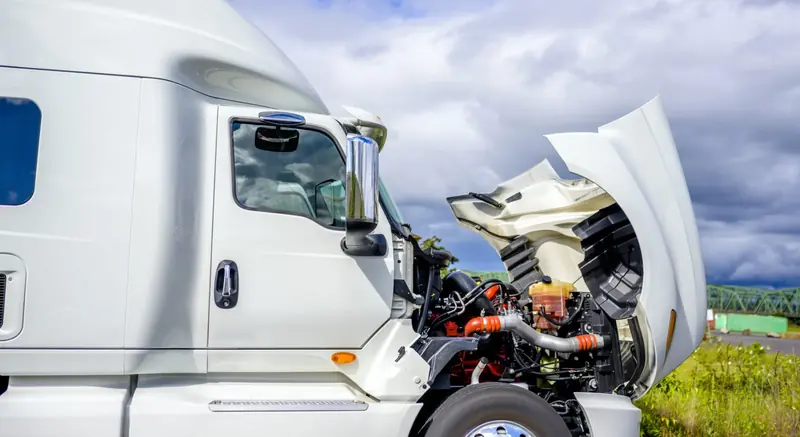
The steering items on the federal annual inspection are steering wheel free play, the steering column, the steering gear box, the pitman arm, power steering, tie rods and drag links.
Sources: Appendix A to Part 396
Does suspension wear show up at a DOT inspection?
Yes. Suspension is its own category on the federal annual inspection standard, Appendix A to Part 396, next to steering and brakes. A truck does not pass that category with any of these:
- U-bolts, spring hangers or other axle positioning parts cracked, broken, loose or missing, where it shifts an axle from its normal position
- Leaves in a leaf spring broken or missing, or leaves displaced where they could touch a tire, rim, brake drum or frame
- A deflated air suspension, from a system failure, a leak or anything else
- Any part of a torque, radius or tracking component, or its mounting, cracked, loose, broken or missing
A PM usually includes a suspension and steering check too, covering springs, U-bolts, air springs and lines, shocks, torque rods, kingpins and tie rod ends.
See DOT inspections for the inspection itself, and fleet maintenance for PM on the schedule a fleet sets.
Sources: Appendix A to Part 396 · 49 CFR 393.207
When does a truck need an alignment?
When it wanders, pulls to one side, runs with the steering wheel off center, or wears its steer tires on one edge. Worn front end parts can cause the same signs.
A full alignment on a tractor covers more than the front. Toe gets set on the steer axle, camber and caster are checked, and the drive axles are measured to be square to the frame and parallel to each other.
Worn kingpins, tie rod ends and torque rod bushings pull an alignment back out, so those get fixed first, and a front end repair can call for an alignment after it.
Which suspension and steering parts do you work on?
A tractor's suspension carries the load and keeps the axles where they belong under the frame, and the steering parts on the front axle get checked with it.
Every suspension and steering part listed here is repaired or replaced in-house.
Air ride
Spring suspensions
Axle location
Steering
Trucks named in reviews
Named in customers' reviews for other jobs, not suspension work.
Rules
The shop behind the work
- Technicians
- About 20
- Trucks we run ourselves
- 55
- In trucking since
- 2013
- Warranty
- 1 to 3 years, by part
Air ride and leaf spring suspensions compared
Both kinds are repaired in-house at the Indian Trail shop, on tractors and trucks.
| Suspension | How it carries the load | What wears | Common signs of trouble |
|---|---|---|---|
| Air ride | Rubber air springs filled from the truck's air system, with a leveling valve holding a set ride height | Air springs, leveling valves and their arms, shocks, air lines and bushings | Sitting low or leaning, a hiss or air loss, bouncing, a harsh ride with a spring flat |
| Leaf spring | Stacked steel leaves clamped to the axle with U-bolts, flexing under load | Leaves, spring eye bushings, hangers, shackles and U-bolts | A cracked or shifted leaf, sagging, clunks over bumps, loose U-bolts |
Suspension jobs
A trailer air bag replaced
- What failed
- The air bag on the customer's trailer needed replacing.
- What we did
- The shop replaced the air bag, and the customer wrote that the crew knew what they were doing.
A truck broken down by a trailer air bag
- What failed
- One of the customer's trucks broke down because of an air bag on its trailer.
- What we did
- The customer called many places, and this was the shop that had someone who could help.
How does a suspension repair go at the shop?
A suspension or steering job usually runs like this.
What the driver noticed
Leaning, sitting low, a hiss, wandering or uneven tire wear is usually where the job starts.
Ride height and air check
Ride height is measured and the suspension's air circuit is checked for leaks.
Suspension and front end inspection
Springs, hangers, U-bolts, bushings, shocks, torque rods, kingpins and tie rod ends are checked for wear.
Estimate and approval
Diagnosis is a flat diagnostic fee, quoted when you call. The estimate for the repair goes to the customer, and parts are ordered once it is approved.
Repair
The repair is done in-house, and repairs carry a warranty of 1 to 3 years, depending on the part and its maker's warranty.
Road test
Ride height is rechecked and the truck is road tested to confirm it tracks straight.
Questions
Is it safe to drive a tractor with a flat air spring to the Indian Trail shop?
Call first. With a flat air spring the axle rides on the spring's bump stop, the truck can lean, and a deflated air suspension is a defect on the federal annual inspection. Say where the truck is and which spring is down. The phone is answered 24 hours a day, and road calls go out day or night, weekends included, up to about an hour's drive from the shop. An air spring can often be replaced where the truck sits. The number is (980) 313-6059.
Do you replace kingpins on trucks from Monroe and Union County?
Yes. Kingpins are replaced in-house at the Indian Trail shop. A kingpin job usually means new pins, bushings, seals and thrust bearings, and the front end work can call for an alignment after it. The signs a steer axle needs its kingpins checked are a truck that wanders, loose steering and steer tires wearing on one edge.
Can Charlotte fleets have suspension and steering checked at PM?
Yes. Fleets can have PM done at the shop on the schedule they set, and a suspension and steering check can be part of it. Both are categories on the federal annual inspection, so a PM that looks at springs, shocks, torque rods, kingpins and tie rod ends can catch wear before an inspector does. See fleet maintenance for how fleet accounts work.
What causes uneven steer tire wear on trucks in the Charlotte area?
Usually the front end or the alignment: toe out of spec, worn kingpins or tie rod ends, drive axles that are not square to the frame, or worn shocks. Low tire pressure wears the shoulders too. Worn front end parts are replaced in-house.
Do you work on Mack and other tractor suspensions in Indian Trail?
Yes. The shop repairs suspensions on every common make: Freightliner, Peterbilt, Kenworth, Volvo, Mack, International and Western Star, from Class 8 tractors to medium-duty box trucks. A Mack owner wrote on Google about finally finding a good shop not afraid to work on a Mack. Customers' reviews name other makes too, though none of those reviews is about suspension work.