On this page
- What diagnostic software do you run?
- What can OEM software do that a generic scan tool can't?
- Parameter changes, updates and ECM programming: what do you handle?
- Electrical faults: how do you trace them?
- How much of a repair is diagnosis?
- Systems, codes and makes
- Code reader, multi-make software or OEM software
- Faults traced
- How does a diagnosis work at the shop?
- Questions
What diagnostic software do you run?
The shop runs heavy-duty diagnostic software that covers the major makes. Diagnostics are done in-house, on heavy-duty tractors, medium-duty trucks and Ram, Ford, Chevy and GMC diesel pickups.
Coverage is the question to ask any shop. A mixed fleet of Freightliners, Kenworths and Volvos can need several different makers' packages, or a multi-make tool that covers part of what each maker's own software does.
What can OEM software do that a generic scan tool can't?
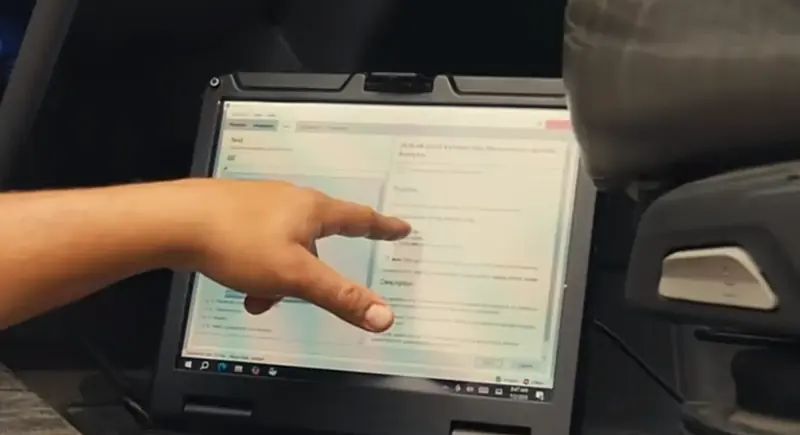
The maker's own software, often called OEM software, can usually go further than a generic scan tool: it reads the maker's full list of faults and data, runs the maker's own tests, and, with the right license, changes parameters and updates the module's software.
A generic heavy-duty scan tool reads the standard J1939 fault codes and much of the live data. Each code has two parts: an SPN, which names the part or signal, and an FMI, which names the kind of failure.
SPN 677 FMI 5, for example, reads as the engine starter relay with current below normal or an open circuit.
Makers sell this software to independent shops. Detroit, for example, runs a program that sells its diagnostic software to independents. Buying a package gives a shop the tool, not the maker's approval.
EPA's July 2026 letter restates that its rules require makers to publish emissions-related service information and to sell manufacturer-specific diagnostic tools to interested parties.
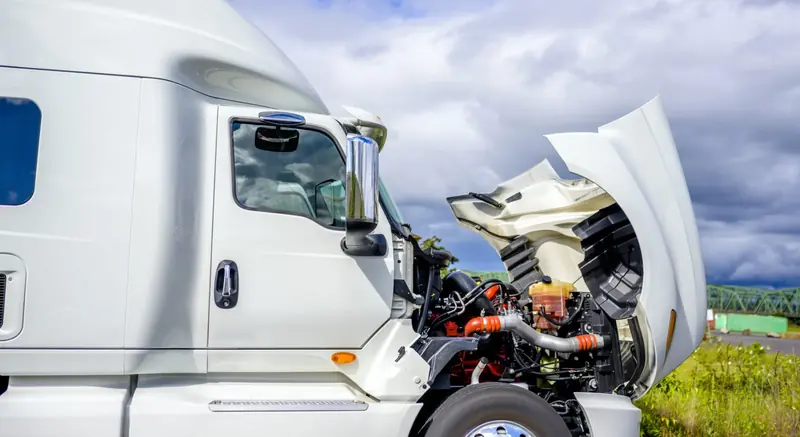
Engine faults the software points to are covered on diesel engine repair, and DPF, DEF and SCR codes on DPF cleaning.
Sources: Detroit: SPN 677 FMI 5 · Detroit: service for independent shops · EPA IACD-2026-08, July 2026
Parameter changes, updates and ECM programming: what do you handle?
Module programming is done in-house at the Indian Trail shop, on the major truck makes.
Parameters are settings inside a module that an owner or fleet can change within limits the maker allows: the road speed governor, idle shutdown time, cruise control limits. An update, sometimes called a reflash, replaces the module's software with a newer release from the maker.
Makers release updates to fix problems found in the field, so a fault that keeps coming back after the parts check out can be a software issue rather than a failed part.
A replacement module needs programming as well. A new engine or transmission controller has to be set up for the truck it goes into, with that truck's engine, options and parameters, before it runs the truck properly.
Electrical faults: how do you trace them?
Electrical faults are traced circuit by circuit: the wiring diagram shows where power, ground and signal should be, and a meter shows where they stop.
One customer's 2023 Peterbilt 579 signaled left all the way back to the trailer, but the right signal stopped at the tractor. A fault like that works up to a point, and the job is finding the point.
The faults that come up most on trucks:
- No-crank and click-only starts: batteries, cables, grounds, the starter relay or the starter
- Charging: alternators, belts, and the cables and grounds between them
- Lighting and trailer circuits: switches, body control modules, the 7-way connector and corroded pins
- Fuses: a fuse box fault, or a short circuit behind a fuse that keeps blowing
- Communication: modules that stop talking to each other on the data link
Customer reviews describe a starter replaced on a Kenworth T680, three new batteries in a truck that would not start, an alternator belt fixed on a road call, and a bad alternator found near Monroe.
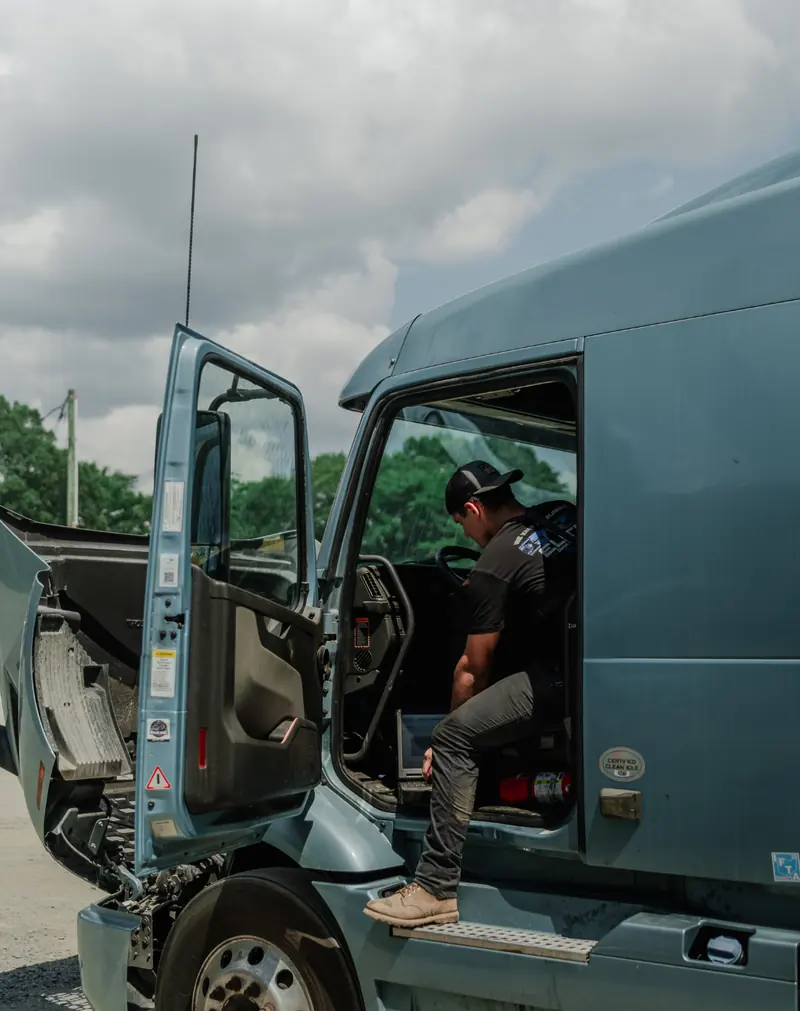
Electrical faults are traced in the shop and on road calls, which go out day or night, weekends included. The repair follows from what the testing finds: a wiring or harness repair, a new module, or work on the lighting, trailer, battery or charging circuits.
Two of the jobs above were road calls. See mobile truck repair, and trailer repair for trailer lights and wiring.
Systems, codes and makes
A heavy truck carries several computers: engine, aftertreatment, transmission, ABS and body controls. They share a data link, and most heavy trucks in North America report faults on it in the SAE J1939 format. The shop is in Indian Trail, Union County, between Matthews and Monroe.
Truck makes
Diesel pickups
Systems on the data link
Read with heavy-duty diagnostic software that covers the major makes.
Faults in reviews
Named as work customers describe.
Trucks named in reviews
Named as work the shop has done.
The shop behind the work
- Technicians
- About 20
- Service trucks for road calls
- 4
- Phone
- Answered 24/7
- In trucking since
- 2013
Code reader, multi-make software or OEM software
What each kind of tool can and cannot do on a heavy truck.
| Tool | What it reads | What it can change | Where it stops |
|---|---|---|---|
| Basic code reader | Standard J1939 fault codes and some live data | Clears codes | No maker-specific tests, parameters or updates |
| Multi-make software | Codes and data from many makes, across several systems on each truck | Some tests and parameter changes, depending on the make and the license | Coverage varies by make, model and year |
| OEM software | The maker's full fault list, data and tests for its own engine or transmission | Parameters, and software updates with the right license | One maker's systems, so a mixed fleet needs several packages |
Faults traced
A 2022 Ram 2500 that several other shops could not fix
- What failed
- Several other shops had tried to diagnose and fix the issue and could not figure it out.
- What we did
- The shop took the time to track the problem down properly instead of guessing, got it fixed, and the truck is running great.
A breakdown near Monroe that turned out to be a bad alternator
- What failed
- The truck broke down in the Monroe area. Of the four shops the driver called, this was the only one that helped.
- What we did
- The problem turned out to be a bad alternator, and the crew got the truck going again.
How does a diagnosis work at the shop?
A diagnostic job usually runs like this.
The complaint
The driver's description comes first: when it happens, what the dash shows and what has already been tried.
Codes and data
The diagnostic software is connected, and the engine, aftertreatment, transmission and ABS modules are read for codes and live data.
Testing
The suspect circuit or part is tested before a part is ordered.
Estimate and approval
The finding and the repair estimate go to the customer, and the repair starts once it is approved.
Repair and recheck
After the repair, codes are cleared and the truck is run or driven to confirm the fault stays gone.
Paperwork
The invoice lists the work done and the parts replaced. Keep it with the truck's records in case the fault comes back.
Questions
Will you look at a truck other shops in the Charlotte area could not fix?
Yes. One customer's 2022 Ram 2500 came in after several other shops had tried to diagnose and fix it and could not, and this shop tracked the problem down instead of guessing. The usual approach is to start again from the codes and the earlier invoices and retest the suspect parts, rather than rely on the last diagnosis. Bring the earlier invoices and any codes that were read, so the same ground is not covered twice.
Do you program ECMs for trucks in Union County?
Yes. Module programming is done in-house, on the major truck makes. Parameters such as road speed limits and idle shutdown are set inside the engine module, and an update loads the maker's newer software into it. A customer's Google review, written in Ukrainian, mentions module flashing.
What should an Indian Trail driver write down before a diagnostic visit?
The fault codes and warning lights on the dash, when the problem happens (cold or hot, loaded or empty, at idle or at speed), how long it has been going on, and any parts already replaced. A phone photo of the dash while the fault is showing helps. Bring earlier invoices for the same problem as well.
Can a no-start be diagnosed where the truck sits in Matthews or Monroe?
Often a no-start can be checked where the truck sits: batteries, cables, grounds, the starter and its relay. Customer reviews describe a truck that would not start fixed with new batteries where it stood, and a starter replaced on a Kenworth T680. Road calls go out day or night, weekends included, from four service trucks, and Matthews and Monroe are well inside the road-call radius of about an hour's drive. See mobile truck repair.
Does a check engine light mean pulling over in Charlotte traffic?
Not always. An amber check engine light means a module has logged a fault, worth reading soon. A red stop engine light, low oil pressure or high coolant temperature means getting off the road safely and shutting down. A Freightliner Cascadia owner wrote that the shop diagnosed a check engine light and erratic rpm correctly.