On this page
- Which diesel engines do you repair?
- What causes power loss and derates?
- Do you fix coolant leaks, radiators and water pumps?
- Turbo, injector or EGR cooler: how do you find the real fault?
- When is an in-frame overhaul the right call, and when is out-of-frame?
- What does engine work carry for warranty?
- How long is a truck down for engine work?
- Engine families and parts
- Repair, in-frame, out-of-frame or replacement engine
- Engine jobs
- How does engine work move through the shop?
- Questions
Which diesel engines do you repair?
The shop repairs engines from Cummins, Detroit, PACCAR, Volvo, Mack and International, in heavy-duty Class 8 tractors and medium-duty trucks such as box trucks. It works on Freightliner, Peterbilt, Kenworth, Volvo, Mack, International and Western Star trucks.
Light-duty diesel pickups from Ram, Ford, Chevy and GMC are worked on as well, but not diesel cars. Customer reviews name trucks rather than engines: a 2023 Peterbilt 579, a Kenworth T680, a Freightliner Cascadia, Mack trucks and a 2022 Ram 2500.
The make on the hood does not settle the engine. A Freightliner can carry a Detroit or a Cummins, and a Kenworth or Peterbilt a PACCAR MX or a Cummins, so have the engine model off its own data plate ready when you call.
What causes power loss and derates?
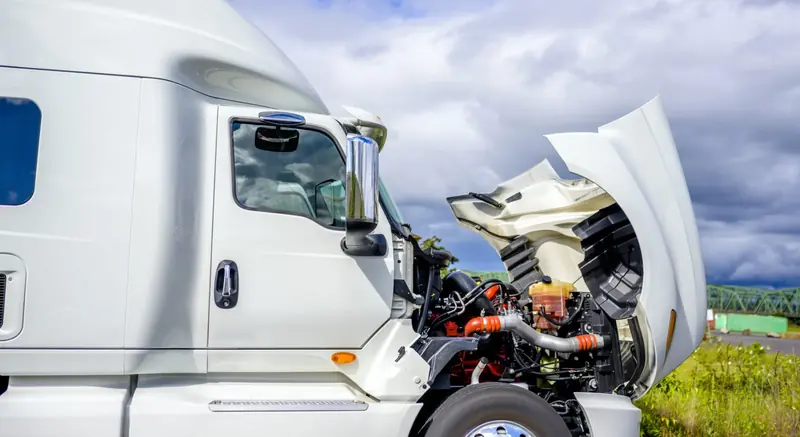
A derate is the engine computer cutting power on purpose, to protect the engine or the emissions system after a sensor reports a problem, so the cause can be mechanical, electrical or in the aftertreatment.
The usual places to look:
- Aftertreatment: a DPF loading up, a DEF quality or dosing fault, or a failed NOx sensor
- Air: a boost leak, a leaking charge air cooler, a sticking VGT actuator or a failing turbocharger
- Fuel: plugged fuel filters, air in the fuel, a weak supply pump, worn injectors or a failing high-pressure pump
- Cooling: high coolant temperature, which some engines answer by cutting power
- EGR: a sticking EGR valve or a leaking EGR cooler
- Sensors and wiring: a failed sensor or a chafed harness can trigger the same protection as a real failure
A truck can still derate today for a DEF fault. Aftertreatment faults have their own page: DPF cleaning.
Do you fix coolant leaks, radiators and water pumps?
Customer reviews describe that work: a radiator leak fixed at the shop, a water pump replaced on a service call, and a leaking bunk heater core bypassed at the roadside.
A coolant leak is worth chasing early. Low coolant can overheat the engine, and coolant that disappears with no drip under the truck may be leaking inside the engine. For a leak that stops a truck on the road, see mobile truck repair.
Cooling system work is done in-house at the shop: radiators, charge air coolers, water pumps, fan clutches, thermostats and hoses.
Turbo, injector or EGR cooler: how do you find the real fault?
The real fault is found by testing before buying parts, because one symptom, such as black smoke, low power or coolant loss, can come from several different parts. What each suspect tends to show:
- Turbocharger and VGT actuator
- Low boost, a whistle, or oil in the charge air pipes. A sticking variable geometry actuator can set codes and cut power while the turbo itself is sound.
- Injectors
- A misfire, rough running, smoke, or fuel in the oil. A cylinder cutout test can narrow a misfire to one cylinder before any injector comes out.
- High-pressure fuel pump
- Hard starting, low power and rail pressure codes. Plugged filters or air in the fuel look the same, so the supply side gets checked first.
- EGR cooler
- Coolant loss with no leak outside, white smoke, or pressure building in the cooling system. A cooling system pressure test helps confirm it.
- Head gasket and oil cooler
- Coolant in the oil, oil in the coolant, or combustion gas in the cooling system. An oil sample can show coolant before the damage spreads.
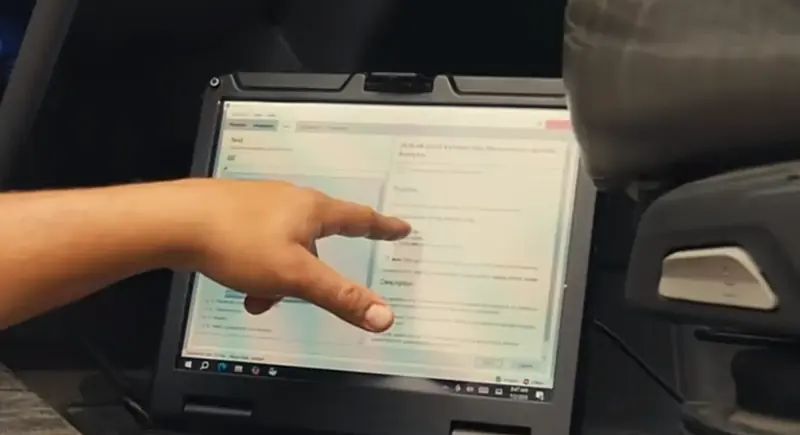
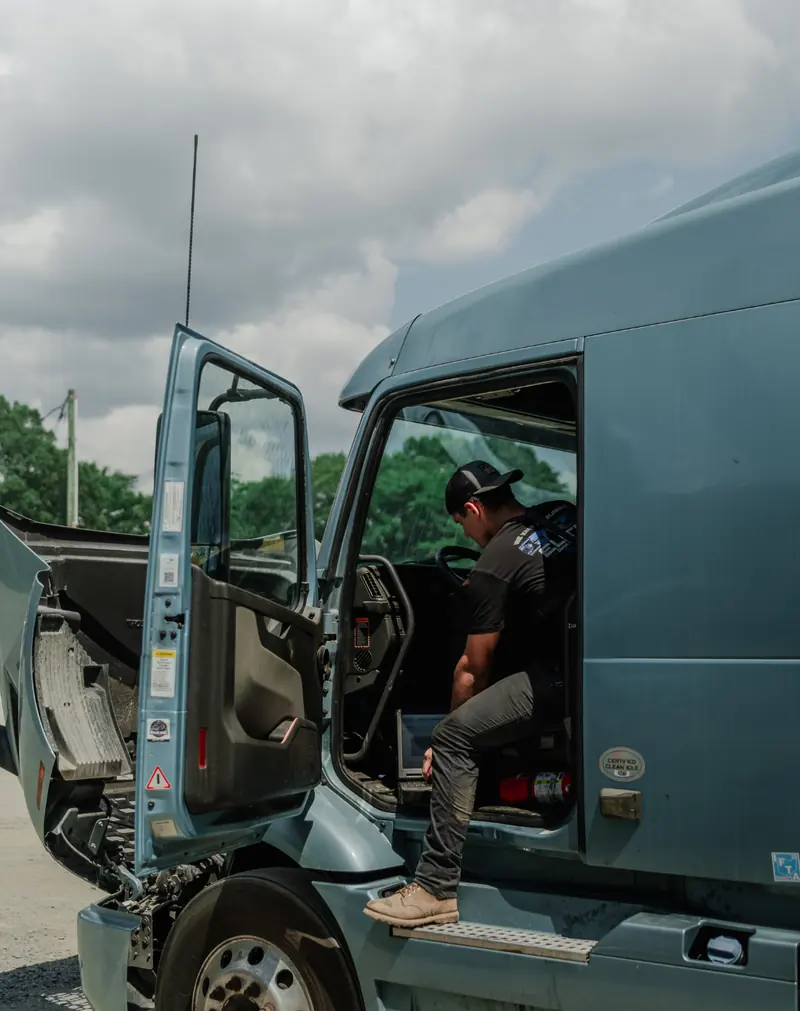
An owner-operator with a Freightliner Cascadia wrote that the shop diagnosed a check engine light and erratic rpm correctly. Before parts are ordered, the fault codes and live data are usually read with heavy-duty diagnostic software that covers the major makes, and the tests that fit the symptom are run.
A failed EGR cooler or valve gets repaired or replaced and the system put back in working order.
Diagnosis is a flat diagnostic fee, quoted when you call. Reading an engine's fault codes and data is covered on truck diagnostics.
When is an in-frame overhaul the right call, and when is out-of-frame?
An in-frame suits a sound block and crankshaft with the wear in the cylinders. An out-of-frame is the call when the damage needs the engine out of the truck and stripped on a stand.
In-frame
The oil pan and cylinder head come off, and the crankshaft and camshaft are inspected in place.
Out-of-frame
A spun bearing that scored the crankshaft, a cracked block, or a failure that sent metal through the engine points this way, or toward a replacement engine.
When the engine comes out, the clutch and flywheel are exposed, which makes it the time to look at them too. See truck transmission repair.
Both kinds of overhaul are done in-house at the shop, on Cummins, Detroit, PACCAR, Volvo, Mack and International engines.
What does engine work carry for warranty?
Repairs at the shop carry a warranty of 1 to 3 years, depending on the part and its maker's warranty.
The term follows the part that went in. A water pump, a turbocharger and a remanufactured engine each come with their maker's own warranty, so two engine jobs can carry different terms.
Ask which term applies before work starts, and get it in writing, including whether the warranty still applies if the truck breaks down far from Indian Trail.
How long is a truck down for engine work?
It depends on the job and the parts. Replacing a hose, a sensor or a water pump is usually the shortest kind of engine job and an overhaul the longest, and a part on back order can hold up any of them.
Three things set the downtime: the diagnosis, whether the parts are on the shelf, and the size of the job. Parts are often the longest wait: one customer's broken camshaft was back-ordered everywhere, and the owner helped track the parts down.
Elite Diesel Solutions runs 55 trucks of its own, local and regional, so the shop knows what a truck off the road costs.
The shop is open 24 hours a day, 7 days a week, so a truck can be brought in at any hour.
Engine families and parts
The shop works on engines from Cummins, Detroit, PACCAR, Volvo, Mack and International. The families below are the heavy and medium-duty diesel engines current as of 2026, plus older engines still common in high-mileage trucks. The shop is in Indian Trail, in Union County.
Cummins and Detroit
Cummins positions the X10 to replace its L9 and X12.
PACCAR, Volvo and Mack
Mack's MP13 followed the MP8.
International and CAT
Navistar is now International Motors. The CAT C15 turns up in older trucks.
Truck makes
Engine and cooling work in reviews
Named as work customers describe.
Engine parts explained on this page
All of these jobs are done in-house.
The shop behind the work
- Technicians
- About 20
- Trucks we run ourselves
- 55
- In trucking since
- 2013
- Warranty, depending on the part
- 1 to 3 years
Repair, in-frame, out-of-frame or replacement engine
| Option | When it applies | What it involves | Downtime |
|---|---|---|---|
| Repair | One part or system has failed and the engine's internals are sound: a turbo, injectors, a water pump, a cooler or a gasket | Diagnosis, then repairing or replacing the failed parts with the engine in the truck | Shortest of the four |
| In-frame overhaul | The block and crankshaft are sound but the cylinders are worn: blow-by, oil consumption, low compression | The engine stays in the chassis. Liners, pistons, rings and bearings are replaced, and the head is reconditioned or replaced | Longer: the engine is rebuilt in the chassis |
| Out-of-frame overhaul | Internal damage an in-frame cannot reach, such as a scored crankshaft or a block that needs machining | The engine comes out and is stripped on a stand. The block is cleaned and inspected, and worn or damaged parts are machined or replaced | Longest of the rebuilds: the engine comes out, and machine work adds time |
| Replacement engine | A cracked block, damage too extensive to rebuild, or a truck that cannot wait for machine work | A remanufactured or used engine goes in, and the old engine is often returned as a core | Depends on when the engine arrives |
All four are done in-house at the shop in Indian Trail. When the parts arrive often sets the downtime more than the work itself.
Engine jobs
A squealing fuel pump
- What failed
- The fuel pump failed and made a squealing noise.
- What we did
- Diagnosis found a loss of fuel pressure and metal shavings in the fuel. The fuel pump was removed and replaced.
A radiator leak on a semi
- What failed
- A semi truck came in on a Friday with a radiator leak.
- What we did
- The shop fixed the leak and had the truck back on the road. The driver wrote about good communication with Dennis and the whole team.
- Time in the shop
- In on a Friday, back on the road that day
A truck that came in misfiring
- What failed
- The truck was misfiring when the driver brought it in.
- What we did
- The mechanic worked on the truck and explained everything he was doing, and it left running better than ever.
How does engine work move through the shop?
Drop-off or road call
The phone is answered 24 hours a day. A truck that runs safely can be driven in, and one that is overheating or deep in derate can be looked at where it stopped or towed in.
Diagnosis
Fault codes and live data are read, and the suspect part is usually tested before anything is ordered. Diagnosis is a flat diagnostic fee, quoted when you call.
Estimate and approval
The estimate is approved before work starts.
Findings once the engine is apart
If the teardown finds more than the estimate covered, the owner hears about it, and the extra work waits for the owner's go-ahead.
Repair and road test
The engine is run and the truck driven to confirm the fault is gone and no new codes have set.
Invoice and payment
The invoice lists the parts used and the labor. Payment is by check, card, cash, Zelle, Apple Pay or Cash App, and fleet accounts get net 30 to 45 terms.
Engine work, from diagnosis to overhaul, is done in-house at the shop in Indian Trail.
Questions
Do you overhaul Cummins and Detroit engines at the Indian Trail shop?
Yes. In-frame and out-of-frame overhauls on Cummins and Detroit engines are done in-house, as they are on PACCAR, Volvo, Mack and International engines. The engine work customers describe in reviews is repair work: a misfire, a radiator leak and major engine issues fixed.
What should a driver do when a truck derates on I-485 near Indian Trail?
Get to a safe spot and note the warning lights and any fault code on the dash before calling. Some derates leave enough power to reach an exit and some do not. If the stop engine light is on, or the engine is overheating or losing oil pressure, shut it down.
The phone is answered 24 hours a day, and road calls go out day or night, up to about an hour's drive from the shop. A mechanic can come out to read the codes on a derated truck, and one that can't be fixed where it stopped can be towed in. Call (980) 313-6059.
Do Charlotte owner-operators get an estimate before engine work starts?
Yes. The estimate is approved before work starts, and anything found once the engine is apart is raised with the owner before it is done. A fleet customer wrote about getting work done to a company truck with a quote first. The shop is not the cheapest, and the work is done properly.
Is an in-frame worth it on a high-mileage truck in the Charlotte area, or is a reman engine better?
An in-frame suits a sound engine with worn cylinders, and a reman engine suits a damaged block or crankshaft. If the transmission, rear ends and cab are worn out too, the money may do more elsewhere. Get both options priced, with the downtime each one means, before deciding.
Can a truck with a coolant leak in Monroe or Matthews be driven to the shop?
Only if the leak is slow and the temperature gauge stays normal. Once the engine has cooled, top up the coolant, then watch the gauge and stop if it climbs. The shop at 225 Garmon Rd Ste K sits off Old Monroe Road between Matthews and Monroe.
If the gauge climbs or the leak is fast, stop and call instead: road calls go out day or night, and a truck that can't be driven can be towed in.