
On this page
- What wears first on an air brake system?
- Drum or disc: what do you service?
- Why do slack adjusters matter at inspection?
- Air leaks, dryers and compressors: what do you fix?
- What puts a truck out of service for brakes?
- Who is qualified to repair truck brakes?
- What does the ABS warning light mean?
- Which brake and air system parts do you work on?
- S-cam drum brakes and air disc brakes compared
- Brake and air system jobs
- How does a brake job go at the shop?
- Questions
What wears first on an air brake system?
On S-cam drum brakes the linings and drums wear first. After them come the parts that move on every brake application: cam bushings, rollers, return springs and the slack adjusters. In the air supply, the air dryer cartridge is a wear item changed on a schedule.
Wear the automatic adjuster cannot make up for, like a worn cam bushing or clevis pin, shows up as a longer pushrod stroke.
- Linings and pads
- Friction material worn thin, cracked, or soaked with oil or grease
- Drums and rotors
- Heat cracks, deep scoring, or a drum worn past the maximum diameter cast into it
- Cam bushings and rollers
- Play in the camshaft, and shoes wearing unevenly
- Brake chambers
- An air leak at the chamber, a loose mounting, a bent pushrod, or a spring brake that will not release
- Slack adjusters
- Pushrod stroke past the readjustment limit for that chamber
Brake jobs are done in-house at the Indian Trail shop, on tractors, trucks and trailers. When the shoes are replaced, any cam bushings, rollers and return springs that show wear are usually changed with them.
Drum or disc: what do you service?
Both. The shop services S-cam drum brakes and air disc brakes in-house, on tractors, trucks and trailers.
Both kinds run on the same air system and apply through a brake chamber. The difference is at the wheel. An air disc brake has a caliper and a rotor in place of shoes and a drum, and its adjuster is built into the caliper, so there is no slack adjuster on the outside to measure.
Its wear items are the pads and rotors, plus the guide pins and seals the caliper slides on. A caliper that sticks on its pins can wear one pad much faster than the other.
A tractor with air disc brakes can pull a trailer with drums, so one combination may carry both. Trailer brakes are covered on trailer repair.
Why do slack adjusters matter at inspection?
Brake adjustment is judged by how far the pushrod travels. A stroke past the readjustment limit for that chamber is a defect at the annual inspection and a violation at the roadside, and it counts toward the 20 percent of defective service brakes that puts a vehicle out of service.
Air-braked trucks and trailers built on or after October 20, 1994 have to have automatic brake adjusters, and where the adjuster sits outside the brake with an exposed pushrod it also needs a brake adjustment indicator (49 CFR 393.53).
Because the adjuster is meant to take up lining wear by itself, a brake found out of adjustment points at something else, usually a worn or seized adjuster or wear in the brake behind it. Turning one by hand shortens the stroke for now and hides the fault, and the stroke tends to come back.
On a brake job or an inspection, stroke is measured with the brakes fully applied, and a stroke that keeps growing is usually fixed with a new automatic adjuster or new parts in the brake behind it.
The rest of the annual inspection is covered on DOT inspections.
Sources: 49 CFR 393.53 · Appendix A to Part 396 · CVSA Brake Safety Week 2023 · CVSA Brake Safety Week 2024
Air leaks, dryers and compressors: what do you fix?
Customer reviews describe a leaking compressor repaired and a compressor governor fixed at the truck. The rest of the air system is repaired in-house too: air dryers and cartridges, valves, tanks, lines and fittings, and gladhands.
The compressor makes the air and the governor sets the range, telling the compressor to stop pumping at the top and start again once pressure drops. The air dryer takes water and oil out of that air before it reaches the tanks.
- Air builds slowly, or the compressor cycles often
- A leak somewhere in the system, or a worn compressor
- A hiss with the brakes applied or released
- A leak at a brake chamber, a valve, a line or a fitting
- Water or oil when the tanks are drained
- An air dryer cartridge past its life, or a compressor passing oil
- Pressure climbs until the safety valve pops
- A governor that is not cutting the compressor out
- The low air warning comes on while driving
- Air leaving faster than the compressor can replace it
On the federal annual inspection, an audible air leak at a brake chamber is a defect, and so are compressor drive belts close to failing and loose compressor mounting bolts.
When the leak starts on the road, see mobile truck repair for how a road call works.
Sources: Appendix A to Part 396
What puts a truck out of service for brakes?
A truck goes out of service for brakes when 20 percent or more of its service brakes are defective, or when an inspector finds a defect that puts it out of service on its own, such as a broken brake drum, a loose air tank, corroded holes in a spring brake housing or a tractor protection valve that does not work.
Brakes are also what inspectors cite most. At CVSA's 2026 International Roadcheck, a three-day event across North America, brake systems were 3,379 of the vehicle out-of-service violations, 24.3 percent of them, and defective brakes another 2,072. These are North American numbers, not North Carolina's.
A truck placed out of service cannot be driven until the repairs on the out-of-service notice are done, and the carrier has 15 days from the inspection to certify that the violations were corrected (49 CFR 396.9).

A mechanic can go out to a truck placed out of service for brakes, day or night, weekends included, up to about an hour's drive from the shop. When the repair cannot be made where the truck sits, the shop can tow it in.
Sources: FleetOwner, August 26, 2026 · CVSA Brake Safety Week 2023 · CVSA Brake Safety Week 2024 · 49 CFR 396.9
Who is qualified to repair truck brakes?
A person qualified under 49 CFR 396.25: someone who understands the brake task and can do it, and is capable of the work through experience, training or both. The rule is written for motor carriers, which may not let an unqualified employee touch brake work.
Qualification comes from an approved apprenticeship or training program, a state certificate for the brake tasks involved, or at least a year of brake training or experience in a commercial garage or a carrier's own shop. There is no federal brake certificate, so the accurate way to describe a technician is qualified under 49 CFR 396.25, with the basis written down.
Brake work at the shop is done in-house by its own technicians.
Fleet accounts are covered on fleet maintenance.
Sources: 49 CFR 396.25
What does the ABS warning light mean?
It means the antilock system has found a fault. The brakes still work, but antilock may be off on some or all wheels, so they can lock up in a hard stop.
Truck tractors built on or after March 1, 1997, and other air-braked trucks and trailers built on or after March 1, 1998, must have ABS (49 CFR 393.55). Tractors built on or after March 1, 2001 also carry a lamp in the cab for faults on the trailer's ABS.
ABS from makers such as Bendix and WABCO reads a speed sensor at each monitored wheel. Faults often trace to a sensor that has backed away from its tone ring, a damaged sensor wire or a corroded connector.
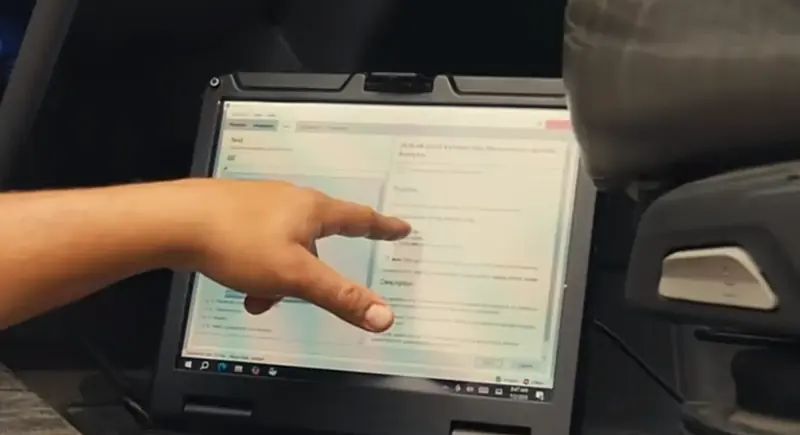
The shop reads the stored fault with heavy-duty diagnostic software that covers the major makes. The fault points to the wheel or valve involved. That sensor, wire or modulator valve is then tested, and the fault is cleared once the repair is checked.
Electrical faults beyond the ABS are covered on truck diagnostics.
Sources: 49 CFR 393.55
Which brake and air system parts do you work on?
An air brake system has two halves that fail in different ways: the air supply, which makes, dries and stores the air, and the foundation brakes at each wheel. Customer reviews name a brake chamber, a compressor and its governor.
Every brake and air system part below is repaired or replaced in-house, on tractors, trucks and trailers.
Named in customer reviews
From customers' Google reviews.
Foundation brakes
Chambers and adjusters
Air supply
ABS
Rules
The shop behind the work
- Technicians
- About 20
- Service trucks for road calls
- 4
- Road call radius
- About an hour's drive
- Phone
- Answered 24/7
S-cam drum brakes and air disc brakes compared
Both kinds are repaired in-house at the Indian Trail shop, on tractors, trucks and trailers.
| Brake | How it applies | What wears | What an inspector checks |
|---|---|---|---|
| S-cam drum brake | The chamber pushrod swings the slack adjuster and turns the camshaft, and the S-cam spreads the shoes against the drum | Linings, drums, cam bushings, rollers, return springs and slack adjusters | Pushrod stroke against the readjustment limit, lining condition, cracked drums, and air leaks at the chamber |
| Air disc brake | The chamber pushes a lever inside the caliper, which clamps two pads against the rotor | Pads, rotors, and the guide pins and seals the caliper slides on | Pad condition, cracked rotors, air leaks at the chamber, and loose or missing parts |
Brake and air system jobs
A brake chamber fixed on a road call
- What failed
- The brake chamber on the customer's truck needed fixing.
- What we did
- The shop's mobile service came out and fixed the brake chamber.
A compressor governor fixed at the truck on a cold day
- What failed
- The compressor governor on the customer's truck needed fixing.
- What we did
- A mechanic came over and fixed the governor in the cold, and the driver was back on the road.
- Time in the shop
- Less than an hour, at the truck
A compressor leaking air
- What failed
- The truck's air compressor was leaking air.
- What we did
- A mechanic fixed the compressor, and the customer wrote that he knew exactly what he was doing.
How does a brake job go at the shop?
A brake job usually runs like this.
What the driver noticed
A pull to one side, a hiss, a low air warning, an ABS light or an inspection report is usually where the job starts.
Air system check
Pressure build-up, governor cut-out and cut-in, and leak-down are checked on the gauges.
Wheel-end inspection
Each brake is checked for stroke, lining or pad wear, drum or rotor condition and chamber leaks.
Estimate and approval
Diagnosis is a flat diagnostic fee, quoted when you call. The estimate for the repair goes to the customer, and parts are ordered once it is approved.
Repair
The repair is done in-house, and repairs carry a warranty of 1 to 3 years, depending on the part and its maker's warranty.
Recheck and road test
Stroke and air pressure are rechecked, and the truck is road tested before it is released.
Questions
Can a brake chamber or air leak be fixed at the roadside near Charlotte?
Customer reviews describe it: a mobile mechanic fixed one customer's brake chamber, and another came out and fixed a compressor governor. Road calls go out day or night, weekends included, up to about an hour's drive from the shop. Brake chambers, air lines and fittings, governors and slack adjusters can usually be replaced where the truck sits. Call (980) 313-6059 and say where the truck is.
What happens when a truck is put out of service for brakes in Union County?
It cannot be driven until the repairs on the notice are done, and the carrier has 15 days to certify the violations were corrected, under 49 CFR 396.9. That usually means a repair where the truck sits, or a tow. The shop sends mechanics out to trucks placed out of service, day or night, and can tow one in. Road calls reach up to about an hour's drive from the shop, which takes in all of Union County.
Does a DOT annual inspection in Indian Trail check the brakes?
Yes. Brakes are the first category in the federal inspection standard, Appendix A to Part 396, covering the service and parking brakes, drums or rotors, hoses, the low pressure warning, the tractor protection valve, the compressor, ABS and automatic adjusters. See DOT inspections.
Should I drive to the Indian Trail shop with the low air warning on?
No. If pressure keeps falling the spring brakes can apply by themselves wherever the truck is. Pull over somewhere safe, set the parking brake and call (980) 313-6059 with the location, the unit number and what the gauges read. The phone is answered 24 hours a day, 7 days a week.
How often should the air dryer cartridge be changed on trucks around Charlotte?
On the interval the air dryer's maker sets for how much air the truck uses, so a truck that makes a lot of stops or runs air-powered equipment can need it sooner. Water or oil coming out when the tanks are drained can mean the cartridge is overdue. Cartridges are changed in-house, and fleets can have them checked as part of PM on the schedule they set.